Innovation at Work
When an industry experiences major disruption, it is often at the hands of innovation. In 2011, the advent of new communication technologies ushered in a rapid change in higher education, especially with the launch of Massive Open Online Courses (MOOCs) and widely available online learning platforms.
Seeing the need for flexible resources to innovate and continue delivering premium learning experiences, the School established the Innovation Fund in 2012. Resources from this fund seed educational innovations in support of new programs, new partnerships and new approaches to learning. To date, 18 individuals and two organizations have joined the Innovation Fund, providing critical resources—$6.2 million in contributions to date—that are flexible in nature.
In 2014, the Innovation Fund supported our efforts to test new approaches and bring new tools and expertise into the classroom.
Educational Expertise
In an effort to anchor and expand expertise in learning techniques and curriculum design, Chris Dakes joined the WSB as the first full-time director of educational innovations and learning design on the UW-Madison campus.
In this new role, Dakes consults with faculty to help articulate learning outcomes for their courses. Clearly defined outcomes bring clarity and accountability around expected skills students will develop, creating shared understanding between instructors, students and hiring partners.
In the last year, Dakes has built support systems for newly hired faculty, complementing their extensive subject matter knowledge with professional development in student-focused teaching and learning. He works to foster understanding through community-building opportunities that shift faculty’s focus from “what am I going to teach” to “what do my students need to learn?”
“We are ahead of the curve, doing things that others have not,” Dakes says. “Now we aim to build momentum, learning from early successes and moving into the curve of change.”
Together,
18 individuals and 2 organizations have contributed $6.2 million toward innovation.
Business for Non-Business Majors
In 2010, Gary Wendt (B.S. 1965) was concerned with the political discourse in the United States, noting that he did not think enough citizens understood the various roles within a market economy. Hoping to improve the conversation, Wendt partnered with WSB to fund an initiative to deliver business fundamentals courses to non-business students. Wendt’s investment resulted in the introduction of two business courses—General Business 310 and 311—that provide an integrated approach to accounting, finance, marketing and management concepts.
Just five years later, more than 2,000 non-business majors have taken the courses. As student interest and demand increased, the Innovation Fund, of which Wendt is now a member, invested in expanding the course offerings to an online audience. Building on best practices in online learning, the course features mini-lectures and thoughtfully interspersed interactive learning experiences. In its first year, almost 400 students participated in the 310 course. The 311 course will be piloted online in spring 2016.
— Chris Dakes Director of Educational Innovations and Learning Design
Google Glass
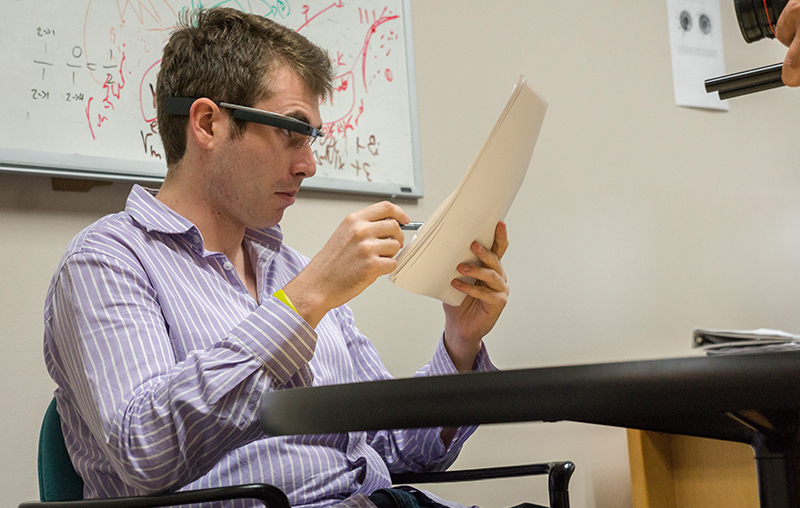
Assistant Professor of Finance Michael Gofman was looking for a solution to a problem many educators face: how to improve feedback to students. In February 2014, he did something revolutionary—he purchased a pair of Google Glass with Innovation Funds for use in his curriculum through the Google Glass Explorer Program.
Rather than marking up papers and assignments, the device allows Gofman and his teaching assistant to record personalized feedback videos for each student. Each video provides information on what they did well, what mistakes they made and how to improve in addition to the grade.
After only one semester of using Google Glass, student evaluation scores that measure the quality of feedback in Gofman’s course increased by 38 percent from the year before.
Gavin Hartzog (BBA ’15, M.S. ’16), who plays on the Wisconsin Badgers hockey team, says the videos were a convenient way for him to get customized feedback on the go. “I continued to replay Google Glass videos so I could identify my strengths and weaknesses to better prepare for the next exam,” Hartzog says. “I think it helped tremendously.”