Pride in Payback
Cindy and Jay Ihlenfeld support the campus that changed their lives.
Photos by Tracy Harris
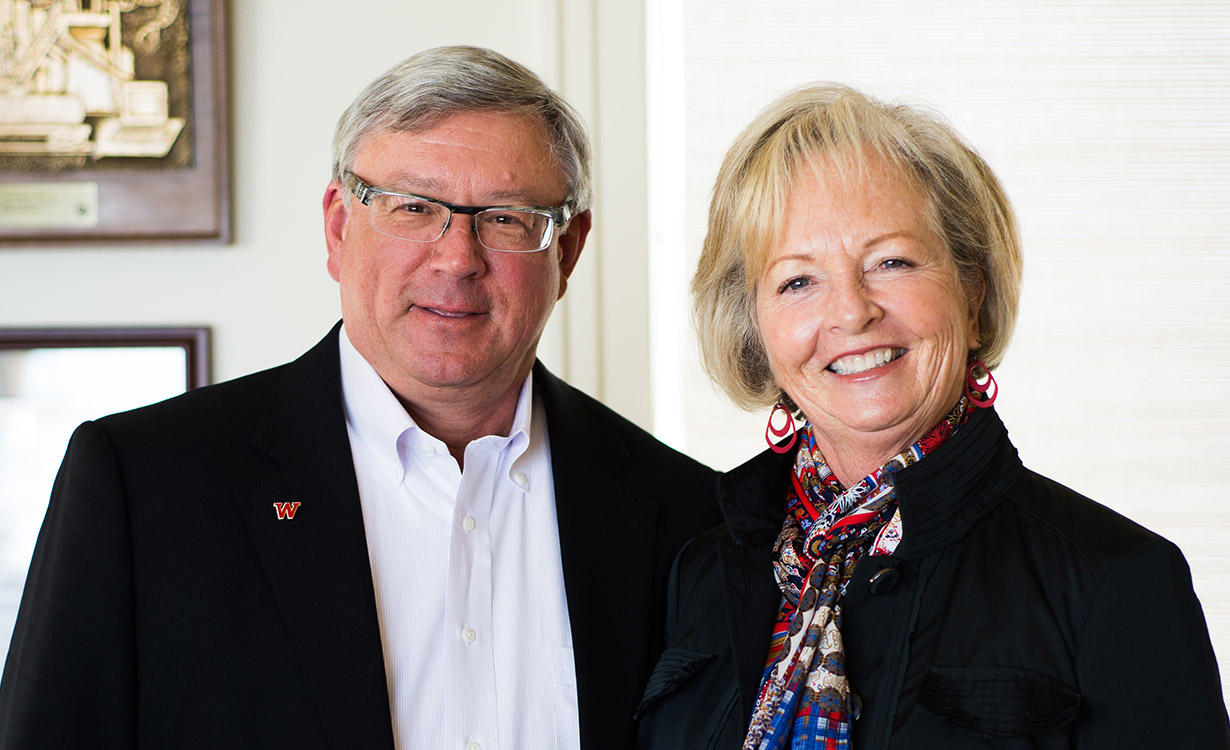
Cindy (BBA ’75) and Jay (Ph.D. ’78) Ihlenfeld describe the experience as almost uncanny: they’re in a crowd—somewhere far from their home in St. Paul, Minnesota—and suddenly they hear “Wisconsin” coming through the otherwise impenetrable local chatter, or spot a flash of red clothing decorated with Bucky. Moments later, the Ihlenfelds find themselves engaged in a warm conversation with fellow UW alumni. “We travel all over the world, and whenever you run into a fellow Badger, you have this immediate connection,” says Cindy. “You can meet people in California or China who went to the University of Wisconsin. You might start talking about your favorite Madison bars or other campus spots.” Even if you majored in different subjects, she adds, “you quickly get into meaningful conversations with fellow Badgers. It’s great to have that instant rapport.”
In a number of strikingly generous ways, the now-retired Ihlenfelds devote themselves to helping ensure that the UW—where people cut across disciplines to share ideas and enthusiastically support the University’s progress—remains a place where academic excellence, zestful problem-solving, and social engagement fuse together beautifully. Each very actively supports the school they graduated from, but together they share Badger pride and an unshakable commitment to championing the University.
Cindy and Jay are from Manitowoc, Wisconsin, where they dated briefly during high school. Their mothers wisely encouraged them to go on another date during college. Both went on to forge highly successful international careers, in business and engineering respectively. Following in the footsteps of her father, Donald Ames, an accountant who graduated from the UW with a business degree in 1950, Cindy was one of only a handful of women studying accounting and finance when she began taking business classes in the early 1970s. By the time she graduated with an honors degree in finance, however, more women had joined the program. Alongside the top-notch instruction and mentorship she received from professors—such as founding director and former CFO of Community Business Bank of Sauk City Robert Cramer, who helped steer her to her first jobs in finance and whom she recently reconnected with—their presence and camaraderie helped give her the confidence she needed to excel in business.
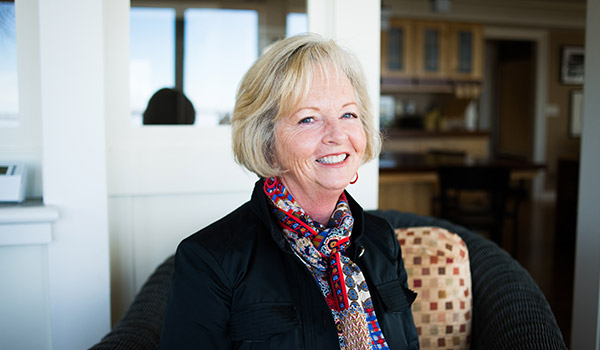
After holding a variety of financial management and business development positions at 3M, Ecolab, and Jefferson Wells (now a division of Manpower) before leaving the corporate world in 2003, Cindy says the experiences and perspectives she gained being an active, open-minded member of the campus community outside of class helped shape her career and continue to influence how she spends her time and energy today. While living in Elizabeth Waters Hall, she managed the dorm’s small convenience store, a student job that allowed her to apply principles of pricing and inventorying from business classes and start figuring out how to manage effectively. She learned at Liz Waters that it is wise to address problems with employees promptly, to help them course-correct or find work they’re better suited for—a lesson she says really carried over into her career.
Over the 18 years she was with 3M, she held several leadership positions in Germany, Belgium, and the Asia Pacific region. Thanks to having had the deceptively instructive opportunity to run a small shop in her college dorm, she always knew that being up front about her expectations would serve her and her employees well in the end: “If you don’t address problems quickly, it gets way more complicated.”
Throughout college, Cindy attended countless art exhibitions and musical events with friends. Jay joined her when he came to UW to pursue a graduate degree in chemical engineering after he graduated from Purdue. Now a practicing mixed media artist as well as an active supporter of several Twin Cities arts organizations—including board positions at the White Bear Center for the Arts and the Weisman Art Museum at the University of Minnesota (where she also earned her MBA)—Cindy credits the tremendous variety of ideas she was exposed to at the UW with helping her develop broad knowledge and imagination. “I think this is Wisconsin’s secret sauce: Whether we’re forced to interact with people in other disciplines by virtue of living together in a dorm, interacting socially, being squished together between two lakes,” or somehow just catching wind of different pursuits happening around the University—she laughs, recalling how breezes wafting over to her at Liz Waters from the campus farm made her more aware of agricultural activity—“we’re exposed to so many new things. I really believe that unless you have good background in a number of different disciplines, you can’t be a good problem-solver. You need both sides of your brain—the creative side and the business side—working together to solve problems.”
—Cindy Ihlenfeld (BBA ’75)
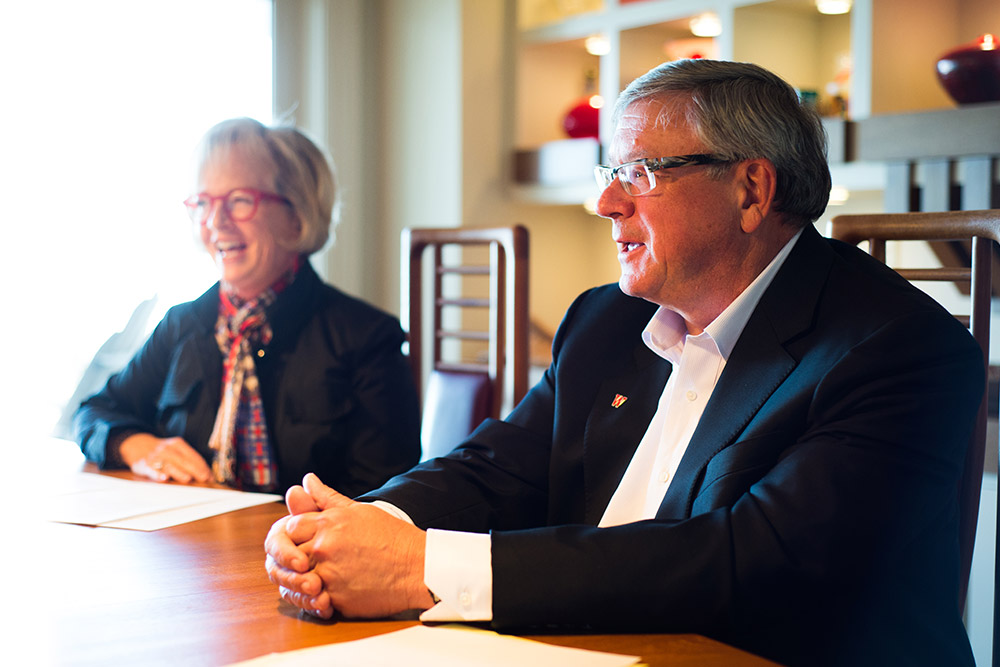
These days, Cindy enjoys sparking new creative connections between “people, organizations, money, and ideas.” As a member of the Dean’s Advisory Board and campaign co-chair for the Wisconsin School of Business, she is closely involved in helping the School continue expanding support for cutting-edge research and innovative learning, as well as increasing its ability to ensure that promising students can flourish at the WSB, regardless of financial need. She and Jay have also jointly created new professorships in both of their respective colleges. The Cynthia and Jay Ihlenfeld Professorship for Inspired Learning in Business will allow a deserving professor at WSB to research and develop novel teaching methods. “We’re always looking for new ways to teach theory in a more meaningful manner. How can we make ideas sink in better? Create a richer and more enjoyable experience for students?” says Cindy, describing the driving idea behind this newly endowed chair. The Jay and Cynthia Ihlenfeld Professorship Fund in the College of Engineering will enable an engineering professor to explore various ways of adapting teaching to suit students with different learning styles. Jay, a former senior vice president at 3M who oversaw Asian operations prior to retiring in 2012, explains the logic here: “When you work for a company for a long time—and I worked for 3M for 34 years—you find out that people learn in different ways and you have to change how you get information to them,” he says. “We have to do the same thing at the University. We want to look at how we can tailor teaching methods to students’ learning capacities, with the idea of—rather than washing them out—how to do you get them through?”
The Ihlenfelds are confident that current and future partnerships between the University and a variety of businesses will go a long way toward helping the UW and its graduates serve society well for generations to come. Jay himself received a fellowship grant from 3M while he was studying chemical engineering at the UW. So, he knows firsthand how mutually beneficial academic-corporate partnerships can be. “To be competitive as a premier global company, you need the best talent, and for major corporations like 3M, there’s no better way to do that than to help make sure that the UW is producing students who can make a difference.” Jay says that one of the best rewards of giving back to the University of Wisconsin is that his personal contributions of time and money actually have begun to feel commensurate with the knowledge and invaluable career preparation he gained in Madison. “Engineering alums look back on their Wisconsin experience as a badge of honor. It’s a tough curriculum, and you’re slogging away in a sea of people having a lot of fun,” he says. “But when you’re done, you feel like you’ve been through boot camp—and you feel incredibly proud about it.”
—Cindy Ihlenfeld (BBA ’75)
Cindy is no stranger to hard work herself, and knows exactly what her husband is talking about. She also thinks it’s only fair for people who are “probably earning a lot more than they ever imagined they would” to repay the School for the “total life experience”—the vivid learning done in and out of classrooms—the UW provides all of its students. “What other organization has had a bigger impact on your life than your alma mater? Your friends, your spouse, your profession: all of these things likely developed through some course or connection you made on campus, an experience you had there. Throughout my career, I really felt the education I received in the Wisconsin School of Business informing the decisions I made, shaping values I tried, and try, to uphold. Being open, up front, trying to understand where people are coming from, working with integrity and gratitude—all of those are huge to me. But these are all really Wisconsin values, and if you’re a Wisconsin graduate, probably no other institution has had as much of a hand in shaping who you are than the University.” And given that tuition still doesn’t come close to covering the financial costs associated with providing students the kind of rich learning opportunities the UW is famous for, she adds, “Isn’t it time to start paying the School back for everything it’s given you? I think of it as payback much more than philanthropy.”

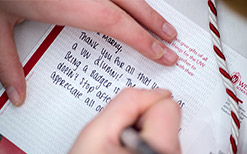


Students Thanking Badgers
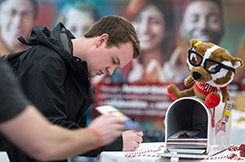
Wisconsin School of Business students thank alumni for their generosity. View Now »
Marisa, BBA
“Donors like you are the reason that students like me have an incredible experience and top education. Your donation supports students’ aspirations and inspires...” Read More »
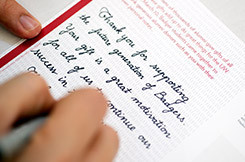
Chris, BBA
“It really makes a difference and means something considerable to students. Your giving does not go unrealized. I have gotten so much out of this program.” Read More »
J.P., BBA
“I’m inspired by your generosity which will help ensure that our institution remains great for years to come. I look forward to joining you...” Read More »