Meet the Dean: Q&A With Vallabh Sambamurthy
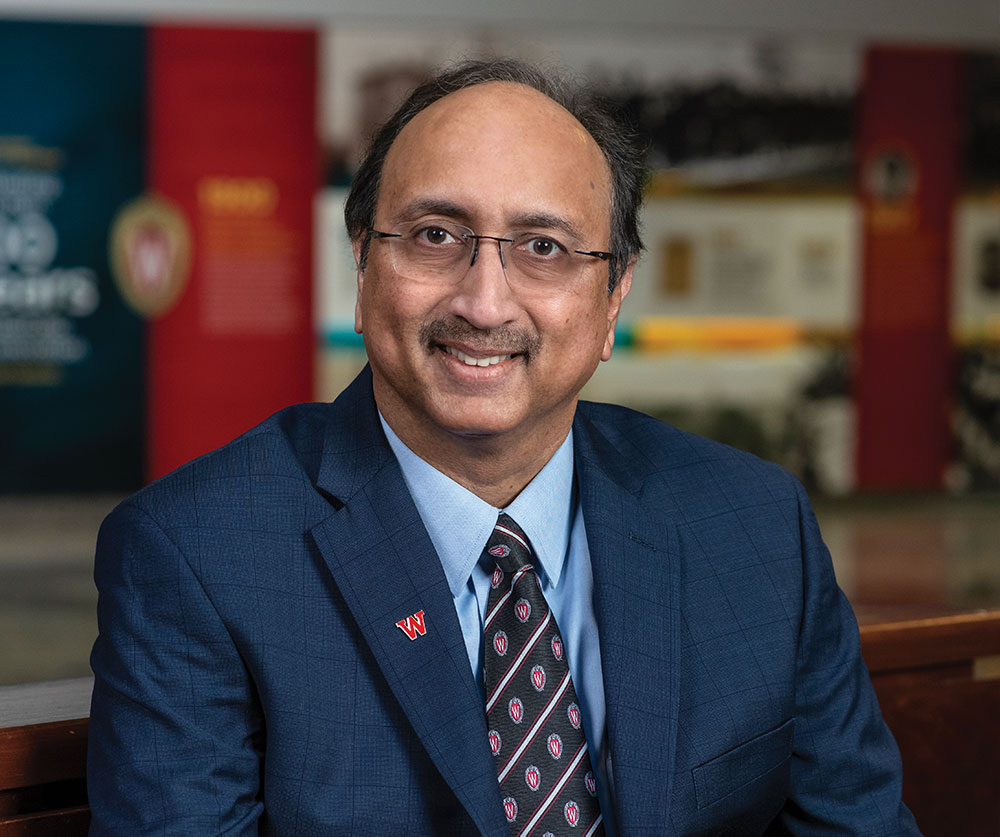
Dr. Vallabh “Samba” Sambamurthy will step into the role of Albert O. Nicholas Dean at the Wisconsin School of Business in August 2019. He already has a vision of what WSB is and can be, and shared some of his thoughts this spring.
WSB: What excites you about WSB and your deanship here?
Vallabh Sambamurthy: The Wisconsin School of Business has a rich legacy as a top business school—for the quality of its education, research, engagement, and impact. It is housed within UW–Madison, which is among the upper echelons of public universities, with many of its colleges recognized as stellar leaders in their disciplines. I am excited to lead WSB to even greater heights in research excellence and impact, innovative curricula and learning platforms, and transformative outreach and engagement.
I am impressed with the caliber of WSB’s faculty and students, as well as the array of alumni in leadership positions at top companies across different industries. As dean, I see WSB perfectly positioned for innovation and growth that not only build on past successes, but also lead us into new opportunities in the global, digital economy.
WSB: What opportunities for innovation do you see at WSB?
VS: I see at least four salient pillars shaping the innovation and transformation opportunities at WSB. The knowledge centers offer unique intellectual capital and a wealth of corporate relationships on their boards. Recent investments in technology spaces and experiential learning provide a platform for educational innovation. Cross-disciplinary research and educational programs are exciting innovation opportunities that can be shaped through collaborative engagements with other colleges on campus. Finally, WSB faculty have the expertise, competency, and motivation to engage in innovative research, education, and outreach.
WSB: What current trends in higher education are you most excited about?
VS: Higher education is truly at an inflection point, buffeted by headwinds, but offering opportunities.
University education and skills are vital for the well-being of global citizens, but the rising costs of education and student debt, as well as demand for relevant, convenient, accessible, and affordable education, has created an environment that demands innovation and creativity.
In the digital economy, the half-life of skills and knowledge is shrinking rapidly. The ability to learn and continually upgrade skills is imperative. As lifelong learners, students will consume education in a more personalized context and demand greater choice in defining their educational experiences, including the selection of degrees and the mode and pace of learning.
Open education models pioneered by Coursera, edX, and Khan Academy are reinventing the learning experience and competing with the value proposition of higher education. Universities should explore deep learning in the form of more unstructured and experiential engagements and multimodal learning—blending the classroom, online platforms, and field experiences.
WSB: How do you see WSB contributing to the Wisconsin Idea?
VS: Business knowledge can be a force for societal good, addressing challenges such as hunger, poverty, sustainability, and health. True to the Wisconsin Idea, WSB can collaborate across campus and partner with industry throughout the state to foster research, learning, and outreach programs that tackle these challenges and upskill citizens. WSB’s knowledge centers can be platforms for disseminating knowledge to industry, from startups to established firms. We will seek new models of corporate engagement to help solve key business problems and achieve transformation in the challenging digital economy.
WSB: Your research focuses on how firms compete in the digital economy. How did you become interested in this field?
VS: Thirty years ago, I realized that information technologies would be transformative during my lifetime. My pursuit of a PhD at the University of Minnesota set me on a journey of scholarship and discovery of how firms leverage information technologies in their business strategies. Field research with many leading firms helped me appreciate not only the potential, but also the challenges, of the impending digital transformation. The emergence of digital giants such as Amazon, Google, Apple, and Netflix piqued my curiosity. I began attending industry conferences, networking with business leaders, and voraciously reading from thought leaders on the digital economy.
Along the way, I learned that the digital economy is dynamic and transformational. As a researcher, it is intensely satisfying to continually discover newer insights that upend and disrupt existing insights. As a result, my own research and educational agenda have continually evolved over time.
WSB: What qualities do you see in WSB alumni? How can alumni help achieve institutional goals?
VS: I can already tell that WSB alumni are passionate about the School, grateful for their experience, eager to engage, and loyal to their alma mater. I see these qualities as a huge asset to WSB’s aspiration of positioning itself as a top business school.
Alumni and donors have a significant impact on the achievement of an institution in ways that go beyond their philanthropic investment. They are our ambassadors into the corporate world and help us to continually enhance our education, research, and outreach agenda, as well as seek opportunities for innovation. In a fast-moving economy, our alumni sensitize us to skills that will make our future graduates valued. Alumni also give back through mentoring younger graduates and advocating for their first job opportunities.
Above all, alumni are our brand ambassadors. Their success and impact reflect on WSB as a place that catalyzes leaders. When they build on that and become donors who also invest in our future, I am delighted to count them as partners in our journey to educate our future workforce.