Space for Inspiration
Grainger Hall's Learning Commons will help transform the way students learn and collaborate

The new heart of Grainger Hall, a collaborative learning space called the Learning Commons, will soon be a hub for students, faculty, industry leaders, and Wisconsin School of Business community members to come together and reimagine what business education can be.
Underscoring WSB’s commitment to educational innovation and following a nationwide trend toward active learning, the Learning Commons will be a donor-funded space for making, doing, producing, and innovating—a vibrant place for students to collaborate, exchange ideas, and dream big.
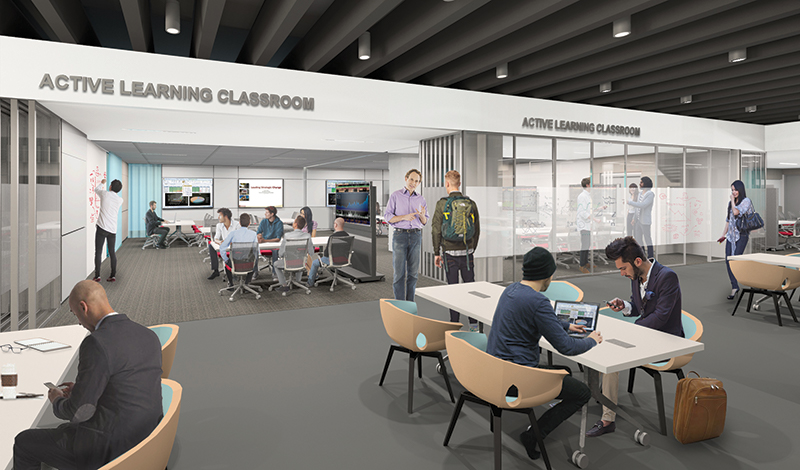
Traditional tables and chairs will give way to spaces for students to gather in groups of all sizes. Flexibility will be a driving force for students to be able to create their own environments and study experiences. Students who work in groups will have a place in the three-level Learning Commons, as will those who want to work alone. Better aesthetics, paired with state-of-the-art technology, will help inspire learning. And it all can happen in a space where active learning and group work just come naturally.
“Learning is social, so it is important for students to have access to environments that can help facilitate group work and encourage more types of active engagement,” says Ron Cramer (B.A. ’91, M.S. ’96), senior instructional designer and learning technology consultant at WSB. “We care deeply about learning and we’re investing in the resources and infrastructure to enhance that learning.”
Construction began in Fall 2017 and is scheduled to finish in Spring 2018.
—Ron Cramer,
senior instructional designer and learning technology consultant at WSB
The Learning Commons was inspired by a student trip to New York City. Through discussions with alumni working on Wall Street, Mark Fedenia (BBA ’77, M.S. ’79, Ph.D. ’87), the Patrick A. Thiele Distinguished Chair in Finance, Director of the Wealth Management and Financial Planning Program, and an associate finance professor, saw a need for a finance-focused computer lab within a new space that would broadly serve the entire WSB community. Continued conversations with WSB alumnus Ricky Sandler (BBA ’91), Michael Enyart, director of the Business Library, and Gwen Eudey, director of the Business Learning Center, sparked the initial idea for the Learning Commons as a collaborative learning space.
“We saw a need for a new finance lab that would give students access to industry software and real-time data, but our vision was much larger than that,” Fedenia says. “We pictured a comprehensive renovation that would benefit students from any major or discipline through a reimagined learning environment.”
A proven model for success at WSB
The team took into account the immediate success of and demand for WSB’s first Collaborative Learning Classroom (CLC), which opened in Fall 2015, and considered other desired innovations: greater opportunities for active learning, streamlined technology offerings, multiple areas for tutoring, a greater sense of community, and unified physical space for the School as a whole.
“Our experience with the CLC indicates that the Learning Commons will facilitate more active learning,” says Chris Dakes (Ph.D. ’98), director of educational innovations and learning design at WSB. “By moving from traditional lecture halls into more interactive spaces, student-to-student learning and direct interaction with their instructor is much more prevalent.”
Research shows the effects of active learning on academic performance are resoundingly positive, and the Learning Commons will help WSB students integrate more of it into their education. Active learning can take the form of authentic real-world team projects, shared reflections, or group problem-solving, and the Learning Commons will provide the perfect setting for all of that to flourish.
“Student success doesn’t just come in mastering course materials, it comes in learning to communicate and work in teams,” says Anne P. Massey, the Albert O. Nicholas Dean of the Wisconsin School of Business. “The innovative space of the Learning Commons will set the Wisconsin School of Business apart in how we prepare students for the workforce of tomorrow.”
Students who use the CLC believe the time spent there is more productive, interactive, and practical than in a traditional classroom. The space enables real-time virtual interactions between students and industry professionals and its pod-shaped tables enhance the group work environment.

—Anne P. Massey,
Albert O. Nicholas Dean, the Wisconsin School of Business
That design did what was intended, says Emily Swift (BBA ’17).
“It forces students to be treated less like students and more like professionals,” she says. “Because we all have technology and computers open in front of us in this learning space, students are forced to be more responsible with their use of technology and to take ownership of their learning in a more active way.”
Marty Kimmel (BBA ’18) sees the potential of the new space.
“Having an environment shaped around bouncing ideas off peers will be much more beneficial to students in classes where group work is a big part of the class,” he says. “I think the Learning Commons will definitely create more opportunities for that kind of work.”
Donor generosity fuels Learning Commons
With $11 million needed for construction, plus an additional $6 million in endowment funds to support ongoing operations, the School has been partnering with the UW Foundation to seek donors willing to fund the entire cost of the renovation. Spearheaded by a lead gift from Ricky and Mara Sandler (B.A. ’91), donors have generously supported this vision with critical gifts totaling just over $9 million to date.
“Our donors recognize the need to create spaces to enhance the innovative, inspiring learning that helps Business Badgers succeed,” says Massey. “Moving technology forward with the Finance and Analytics Lab will provide a tremendous tool for recruiting faculty, staff, and students, as well as give our students a hands-on learning experience that will prepare them for their careers.”
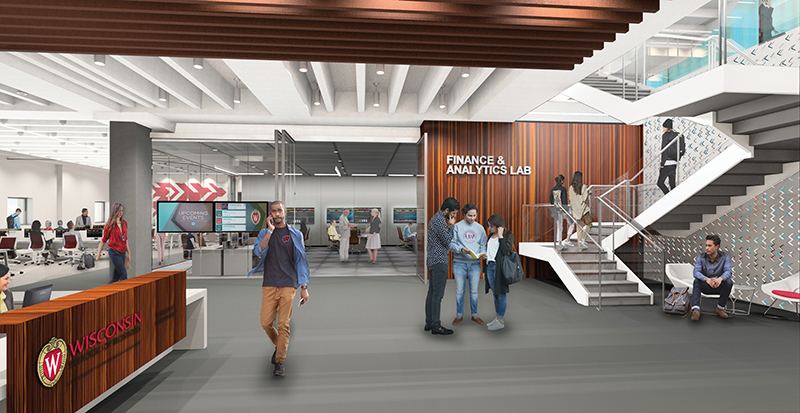
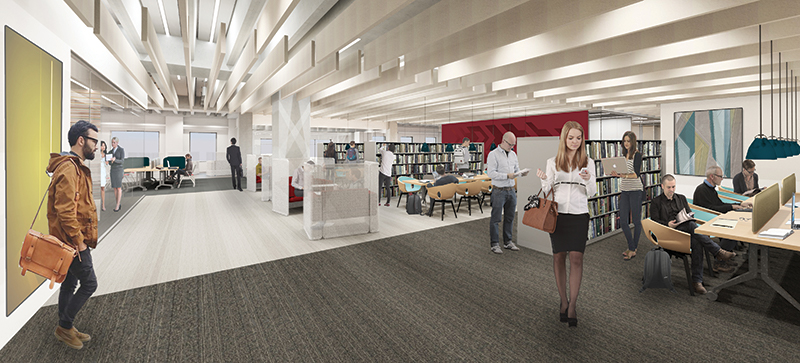
The transformation will happen on three floors of Grainger Hall areas that many alumni would remember as the Huber Undergraduate Computer Lab and the Business Library. The first floor, once home to the computer lab, will be the Finance and Analytics Lab with the upper areas providing a variety of learning spaces for individual and group work in formal and casual settings.
“We were always crowded with students,” Enyart says of the original Business Library. “The renovation will not only give us more and better space, but more importantly, it will be an incredible opportunity for student learning and collaboration.”
The dynamic, cutting-edge environment of the Learning Commons will create a crossroads of activity within Grainger Hall, a central hub for interdisciplinary sharing across campus and student communities. It will be a space where the “four Cs” that inform the Learning Commons design—creativity, collaboration, critical thinking, and communication—can naturally take place.
“Learning doesn’t just happen here in the classroom, it happens everywhere,” says Cramer. “The knowledge that people have out in the field, in business, their experiences as alumni, we need them all to benefit our students. This space will provide a common area where people feel welcome to meet together, to share, and to learn from one another.”