Inspiring with Expertise
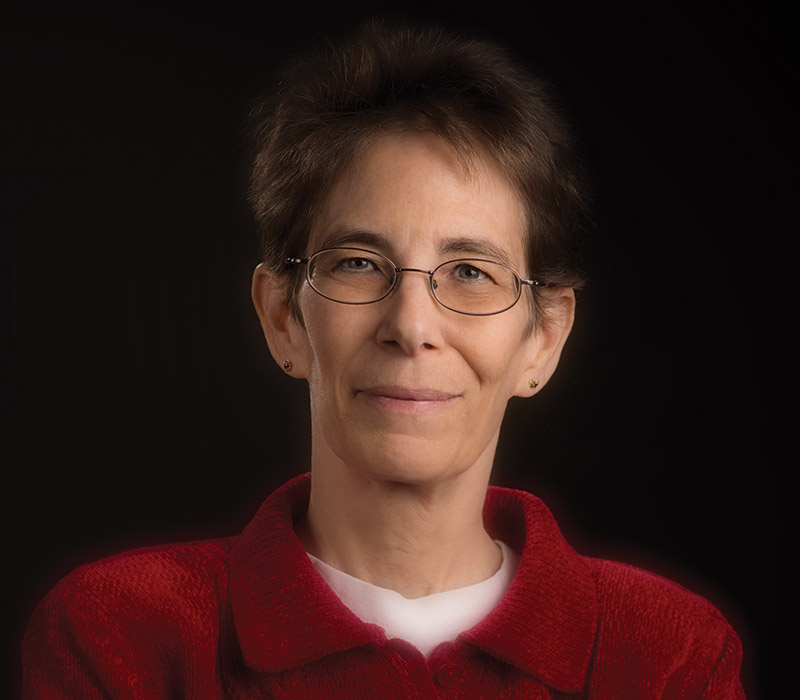
After more than 20 years with the Wisconsin School of Business, Marjorie “Margie” Rosenberg, professor of risk and insurance and Assurant Health Professor of Actuarial Science, is melding her passion, talent, and health care expertise in a new way, and students are reaping the benefits.
“Until the creation of the Health Analytics course, I never taught classes that directly related to my research as some others have been able to do,” Rosenberg says. “I am excited I can do that now.”
A big data approach to a personal topic
In the Spring 2015 semester, Rosenberg began teaching Health Analytics, in which her longtime research in health care feeds the class and the class feeds into her ongoing research. It is the most recent way Rosenberg has combined analytics and health care data, following her joint appointment in the UW School of Medicine and Public Health’s Department of Biostatistics and Medical Informatics from 1996 to 2014.
Rosenberg’s current research involves development of statistical tools and methods to analyze health care utilization and costs. One continuing focus has been to study medical costs of pediatric cystic fibrosis, while past work has covered breast cancer, tobacco-related diseases, and end-of-life care. Published in top journals such as Medical Decision Making, Pediatrics, and the North American Actuarial Journal, her research has earned her the prestigious Halmstad Prize for best paper in actuarial research, the Lew Award for achievement in research, and many other accolades.
Her expertise helps her guide undergraduates through the ever-changing field of health care research from a big data perspective while maintaining focus on the individuals affected by changes in health care policy.
“I like to think of improving the health of the community, not as an actuary or even as an academic, but as a person,” Rosenberg says. “The excitement of health care is that it is personal, and it is important financially. Almost 20 percent of our country’s GDP is spent on health care, which is why people are concerned about the cost. Health care policy provides fascinating moral and ethical discussions.”
It is a discussion that can animate her students, too, she says.
“When we discuss articles I ask, ‘What are your thoughts as an individual? Never forget that,’” she says. “It is good to have a system perspective, but you do not ever want to forget the viewpoint of the consumer.”
“Margie Rosenberg has proved to be an inspiring teacher,” says Joan Schmit, professor and American Family Insurance Distinguished Chair of Risk Management and Insurance. “She has taught our core MBA data course, our varied actuarial science courses, and now the new Health Analytics course, all with an active learning approach, instilling each course with her own industry experience, the knowledge gained from numerous important research initiatives in the health care field, and a desire to offer students opportunities for personal development.”
A passion for inspiring learning
Rosenberg did not start out working in health care or academia. After graduating with first a bachelor’s degree and then a master’s in mathematics from the University of Michigan, she worked as an actuary for Allstate Life Insurance.
“I did not even learn about actuarial science until I was a junior in college,” she says. “Now students know about it when they are a sophomore in high school.”
—Margie Rosenberg
Assurant Health Professor of Actuarial Science
Rosenberg applied her analytic skills to pricing life insurance, but after 11 years, she felt the pull of research and teaching.
“I love learning, and I love thinking,” she says. “I love thinking about processes and how they interrelate. I like to see the big picture and how the components interrelate.”
That was part of the draw of focusing her research on health care—a focus that started with her dissertation.
“The U.S. health care system is complex with different stakeholders who have different viewpoints on what they label as ‘success,’” she says.
After returning to Michigan for her Ph.D. at the Ross School of Business, Rosenberg joined the faculty of the Wisconsin School of Business in 1994. She was thrilled to rediscover learning—and share her passion for it—in a university environment.
“The notion of teaching activates one part of you, that connection with the students,” she says.
It is a connection that students appreciate.
“Professor Rosenberg has a passion for what she teaches, and I can tell that she wants others to find their own passion as well,” says Olivia Wirz (BBA ’16), who took Health Analytics in Spring 2015. “She always has an example or an application that validates the purpose of what we learn in class, but she also encourages us to find our own interests.”
—Olivia Wirz (BBA ’16)
Rosenberg has taught every class in the actuarial science major; recent classes include Actuarial Mathematics and Regression and Time Series. The life insurance class helps prepare students to sit for one of the professional exams for actuarial certification.
With the life insurance class, Rosenberg says, “I infused my work into the classroom, but I just never put my research into the classroom. To now have the teaching and the researching together is a dream come true.”
Classroom collaboration brings research insights
Health Analytics began as an experimental class and was offered a second time in the Fall 2015 semester. It was partially funded through a course development grant from the Robert Wood Johnson Foundation Health & Society Scholars program.
It is a challenging class, one in which the students have a big say in the syllabus because of the readings they choose to discuss in the classroom. Students choose peer-reviewed research articles to discuss in class. Content could come from the Journal of the American Medical Association, Medical Care, Health Affairs, Statistics in Medicine, and any number of statistics or health care journals.
“For my learning, it is great,” Rosenberg says. “We have different journals that I have never heard of before, and subjects I would never choose to read myself. Some of the information is just educational, but some might help me in my research. That knowledge helps me in my future classes.”
Topics might include researching the difference in expenses between people with disabilities and the able-bodied; how diabetes impacts health expenditures; or how having insurance affects health care spending.
“The students look at it from all different angles, so it is good education for them going forward because they are going to be impacted by the health care system at some point,” she says.
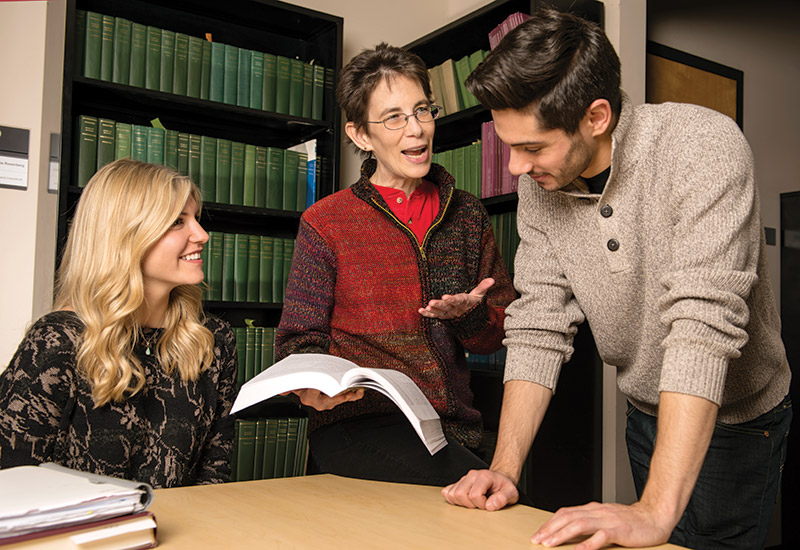
Students discuss the chosen paper in small groups while also asking questions about what was not understood or broader discussion questions relating to the material.
Jake Corrao (BBA ’17) took the class, drawn to the subject by Rosenberg’s expertise.
“I can see myself working in the health care industry as an actuary, so this new course taught by a health care expert offered a perfect opportunity to dive into academic research surrounding issues in health care and health insurance,” he says. “It turned out to be a great experience to be able to learn from someone who has so much to teach.”
Looking past data to individuals
Beyond the work relating to the peer-reviewed literature, students also apply their analytics knowledge to replicate the findings in the article using statistical methods and programs.
Corrao worked on a project that was focused on a paper the class discussed about free prescription drug samples. Using the same statistical methods of the paper’s authors but with data from 2012 instead of the paper’s original 2003 data, Corrao essentially wrote a sequel to the paper’s findings. The original paper concluded that the end result of the free samples served more as a marketing tactic than in helping people with less money access the drugs. Corrao’s new analysis suggested that the giveaways had decreased in the past decade, likely because of the impact of the original paper.
“To be able to observe what is in the industry, consider what may be causing things to change, and then test these hypotheses through data analysis was a very rewarding process,” he says.
At the heart of the class is the Medical Expenditure Panel Survey (MEPS), a free and easily accessed data set that provides the most extensive data about costs and use of health care and health insurance in the United States.
Familiarizing students with MEPS gives them real-world data analytics experience and a valuable research tool of their own, Rosenberg says.
“It is a hugely rich data set,” she says. “If they go to work in health care, they can take it with them and who they work for may or may not know about it.”
Each calendar year of data contains two panels of data from approximately 18,000 people on their expenditures, prescriptions, health habits, and demographics. Through statistical modeling, that 18,000 can be made to be representative of the entire noninstitutionalized population of the United States.
“This data set was used in policymaking decisions,” Rosenberg says. “It was used in Medicare Part D prescription drug pricing. It is probably the only survey of expenditures of people who are uninsured, so it is a nice data set to look at before and after the Affordable Care Act.”
Rosenberg’s research will continue to inform her teaching because her subject matter is continuing to evolve, something every student and consumer knows.
“Health care is dynamic, there are new technologies coming, new drugs coming,” she says. “It is changing all the time.”