A Head Start for a Startup
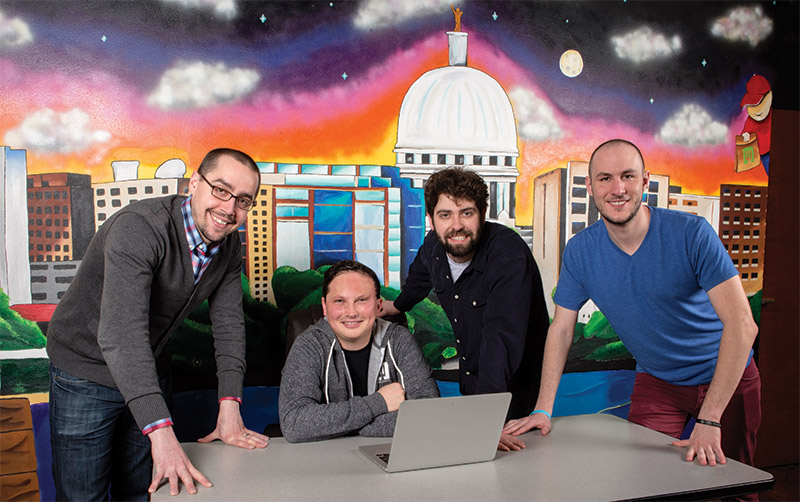
When the founders of EatStreet had the idea for an online restaurant ordering service, they searched for “how to start a business” on the Internet, but it was the personal connections they made through the Wisconsin School of Business that set them on the road to success.
Matt Howard (B.S. ’11), Eric Martell (B.S. ’12), and Alex Wyler weren’t business majors at UW–Madison, but they met committed mentors and key investors through the WSB. As an economics major taking business classes, Howard discovered the School’s annual business plan competition and entered with Martell and Wyler.
The WSB contest was more than a line on their résumés—it was an introduction to people who would be important to the future of EatStreet, including:
- John Surdyk, director of the Initiative for Studies in Transformational Entrepreneurship, asked the tough questions necessary to turn an idea into an operation.
- Dan Olszewski, director of WSB's Weinert Center for Entrepreneurship, made an introduction that secured the company’s first major commitment of Series A funding.
- Jon Eckhardt, associate professor of management and human resources, Robert Pricer Chair in Enterprise Development, and executive director of the Weinert Center, connected them to gener8tor, the Wisconsin-based angel investment fund and startup accelerator that provided $150,000 in seed money.
In the six years since entering the contest, EatStreet has grown to 130 employees supporting 15,000 restaurants in 250 cities. In December, the startup got $15 million in Series C funding, bringing its total from investors to nearly $30 million since the three founders each kicked in $1,000 of their own money to launch the company.
EatStreet by the Numbers
130
employees
15,000
restaurants in
250
cities
Howard, the company’s CEO; Martell, who is CIO; Wyler, now CTO; and Rob Polenska (BBA ’06), vice president of marketing, sat down with Update magazine to explain how the Wisconsin School of Business helped them grow.
WSB: How did you know what the Wisconsin School of Business had to offer?
Martell: We entered the business plan competition in 2010 and 2011. In 2010, four teams got prize money, and we tied for last place. That’s how we met John Surdyk. When we didn’t do so hot the first year, he realized we needed all the help we could get. In 2011, we came back and won the competition.
Howard: The best thing about the contest was how the judges really became mentors. I think they saw we were on to something. I still talk to Scott Button (B.S. ’88), partner at Venture Investors, and Laurie Benson (B.S. ’75), co-founder and former CEO of Inacom Information Systems, who were judges the year we won.
—Matt Howard (B.S. ’11)
Founder and CEO, EatStreet
WSB: What did you learn between coming in last in 2010 and winning in 2011?
Wyler: We weren’t used to getting critical feedback until we started talking to business school people. They gave us constructive criticism in a way that motivated us instead of making us hang our heads in defeat. They talk about failure in a really good way, in a way that other sectors aren’t used to.
Howard: People like Jon Eckhardt helped open doors and make connections. He recommended I reach out to other entrepreneurs, go to conferences, and get as connected as possible.
Without him, I never would have met anyone at gener8tor. Without Dan Olszewski, I would have never gotten my Series A funding. Then that group of investors got me to the $2 million investors, who got me to the $10 million investors. This is why I call the University of Wisconsin my first investor.
WSB: How has it helped to have Rob and his marketing expertise?
Wyler: Rob joined when we were transitioning from “Let’s hire all our friends” to “Let’s hire experts.” He helped us grow hugely in 2014 and 2015.
Polenska: Marketing and entrepreneurship go hand in hand because growth for a lot of companies comes from marketing, whether it’s advertising or collaborating with the product team.
WSB: Did you know the importance of networking when you launched your company?
Howard: I did not. When we first entered the competition, I never asked one person for advice. We were already a company for 10 months at that point. I didn’t think I had the answers, it just didn’t occur to me there were people who would give me advice.
After the competition, I understood the importance of networking. I started going to conferences, speaking at conferences, and meeting more people. It’s so important.
Learn more about the WSB programs and resources for entrepreneurs: