To be known as a “Bolzie” is to be known as someone with a passion for the arts, a skill set in management, and a life punctuated by creativity. It may not be a widely recognized term, but for those familiar with it, “Bolzie” is a powerful identifier—one that has been 50 years in the making.
The Bolz Center for Arts Administration at the Wisconsin School of Business (where “Bolzies” are born) celebrates a season of milestones during the 2018-19 academic year with doubleheader anniversaries and a host of opportunities for students, alumni, and friends to honor the program’s deep legacy and ongoing influence.
This year marks the 50th anniversary of the arts administration degree program at UW–Madison and the 25th anniversary of the Bolz Center for Arts Administration naming gift. Both occasions are cause for celebration, signaling the pivotal role that this institution has had in shaping a field of study and educating scores of artful leaders.
A founding visionary
Half a century ago, the nonprofit arts industry in America was enjoying rising prominence, evidenced by the launch of the National Endowment for the Arts in 1965 and the growth of foundation funding and cultural spending. With arts organizations forming and expanding across the country, the demand for individuals to manage them grew in tandem.
E. Arthur “Al” Prieve, a UW–Madison management professor, was among the first to recognize the need to train professionals to address the specific needs of this emerging field. With pioneering vision, he developed in 1969 the first and only graduate-level arts administration program founded and based in a business school.
“This program grew out of a strong desire to bring business theory to the arts and to upgrade management capabilities in the arts,” says Jack Nevin, an emeritus professor who was a close colleague of Prieve and a collaborator in the early days of the program. “Al dedicated his professional life to this work.”
Prieve, who passed away in 2014, is widely recognized as a forefather of the arts management profession. He understood early on the importance of developing arts leaders with broad-based business acumen, and he helped shape the School’s arts administration degree from the time of its founding until his retirement in 2000.
“Course by course, connection by connection, [Al] defined an entire field and the skills required to serve it,” says Andrew Taylor (M.A. ’94), who studied under Prieve and succeeded him as director of the Bolz Center. “He developed several generations of arts leaders that contribute to its vitality today.”

From one family, a gift for many
The arts administration degree program at UW–Madison flourished over the next several decades, as universities across the country began developing similar programs, though few, if any, based in a business school. To build a foundation for the program’s long-term impact, the Bolz family—who had deep connections to the arts industry in Madison and a close relationship with Prieve—provided generous endowment support in 1993. Henceforth, the degree program became known as the Bolz Center for Arts Administration, named in recognition of Robert, Anne, John “Jack,” and Marian Bolz, and the Eugenie Mayer Bolz Family Foundation. Together with support from other alumni and friends, the Bolz endowment helps to defray costs by providing partial tuition assistance to students and funding other programmatic needs.
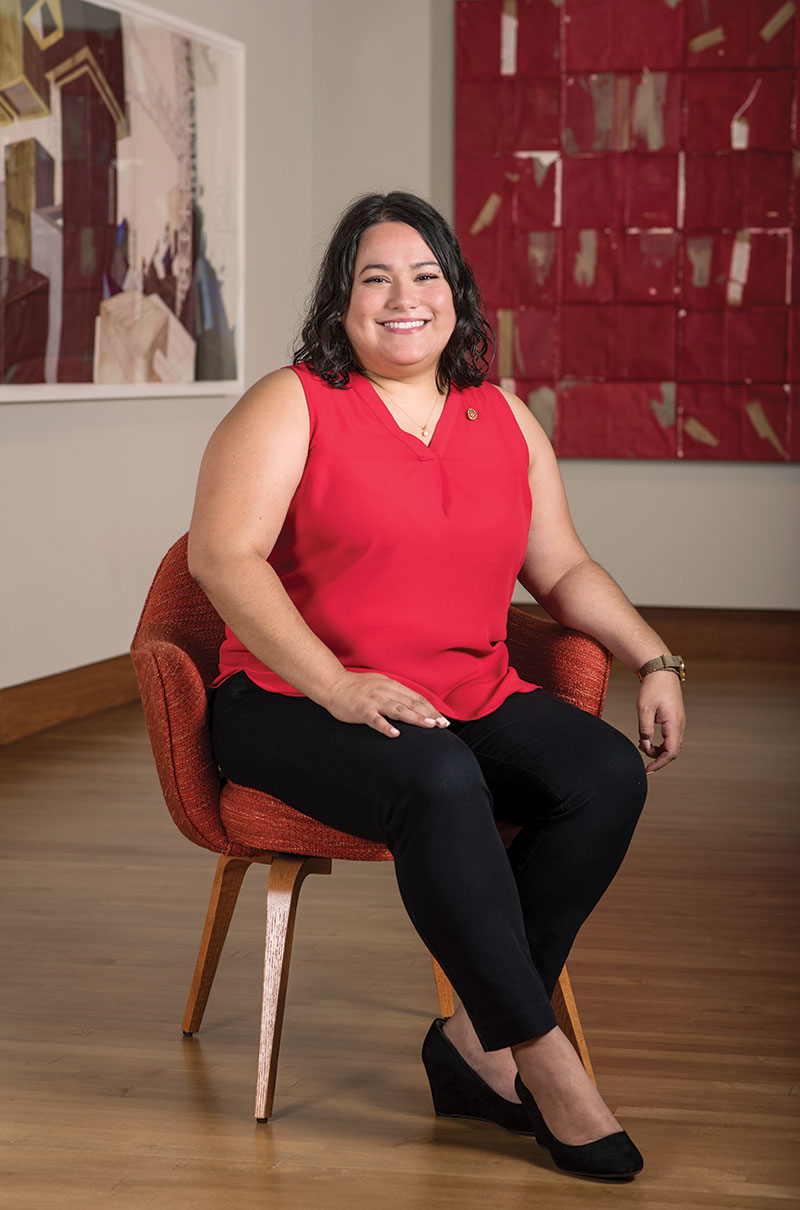
“The generosity of the Bolz family gift lifted the burden of tuition and, above all, it afforded me an experience that has transformed the way I think, act, and lead,” reflects Sarah Sosa-Acevedo (MBA ’16), an advancement associate at the Smithsonian Institution. “Wherever I go, I am confident of the education I received, and I am proud to call myself a ‘Bolzie.’”
— Sarah Sosa-Acevedo (MBA ’16), Advancement Associate, Smithsonian Institution
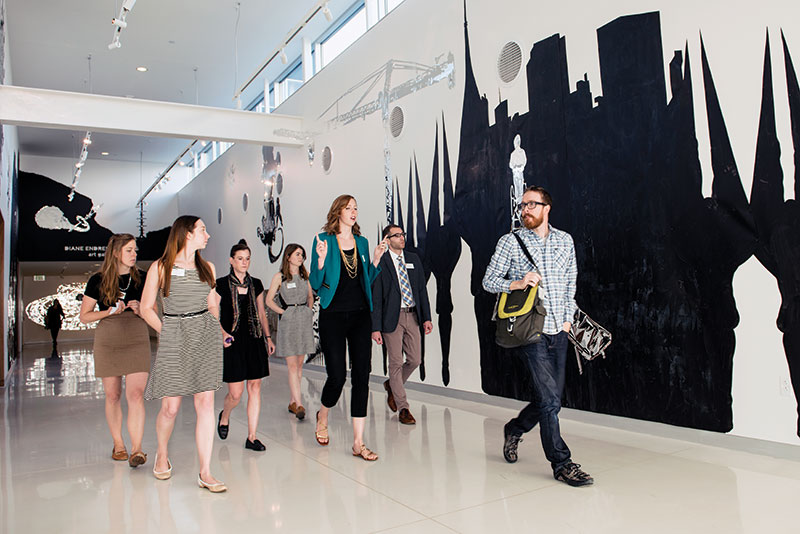
The Bolz family funding also makes possible a hallmark of WSB’s arts administration degree: applied learning project placements in arts and culture organizations that provide students with real-world experience and on-the-job application of classroom learning. Current students are working at local organizations such as the Overture Center for the Arts, the Chazen Museum of Art, and Wisconsin Union Theater, providing value to these institutions while deepening students’ learning and building their résumés while still in school.
For Jack Bolz, the opportunity to support students in this type of learning is as rewarding today as it was 25 years ago when his family first made the gift.
“I have always been highly impressed with the caliber of people that go through this program,” says Bolz. “Times have changed radically and audiences are much different. The appeal is different, and it takes people with a graduate degree specialized in the arts to recognize these changes.”

An evolving degree with growing reach
Over the course of the Bolz Center’s history, the degree program has continually evolved. Up until 2006, graduates received a Master of Arts in Business with a major in arts administration. In 2006, the degree shifted to become a Master of Business Administration.
Today’s program blends intensive business study, hands-on experience, and professional networking opportunities. Bolz Center students take general management courses throughout their two years of study, as well as a specialized arts administration seminar. In their second year, students hone their managerial skills through consulting projects that bring teams together to analyze the marketing, finance, human resources, and organizational strategies of arts-related organizations.
“Bolz students bring a diversity of thought to our business curriculum,” says Don Hausch, who has been faculty director of the Bolz Center since 2004. “They pose hard questions and offer challenging answers based on their experiences and perspective from the nonprofit, mission-based sector, which enriches the conversation inside and outside the classroom. The arts administration program is an asset to all of us at WSB.”
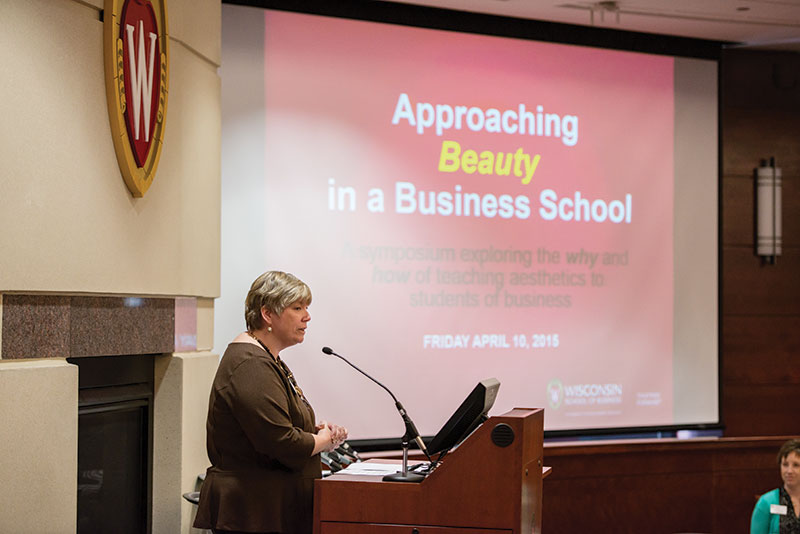
Sherry Wagner-Henry, who became director of the Bolz Center in 2012, has deepened the impact of the Bolz Center, extending the Center’s reach beyond its cohort of students to serve others across WSB and UW–Madison. Wagner-Henry launched the campuswide Arts Business Initiative, a program that connects creative majors to business students and curriculum. She also helped define the role for WSB’s first artist-in-residence and has been a key player in shaping how the School integrates the study of business and the humanities.
“Over the last several years, we’ve seen an increasing realization of the role that the arts and creativity play in developing well-rounded, thoughtful leaders,” says Wagner-Henry. “The Bolz Center is well positioned to create innovative learning opportunities at the intersection of many disciplines, and it has been my honor to shepherd the growth of the program in this way.”
In July 2018, Wagner-Henry was appointed by UW–Madison Provost Sarah Mangelsdorf to an evolving role as director of campus arts and business initiatives. This appointment recognizes the groundwork laid by WSB to create collaborative opportunities for business students and creative majors. It also signals support for increased interdisciplinary programs and creative placemaking efforts across multiple units, with guidance and partnership from UW–Madison’s Division of the Arts.
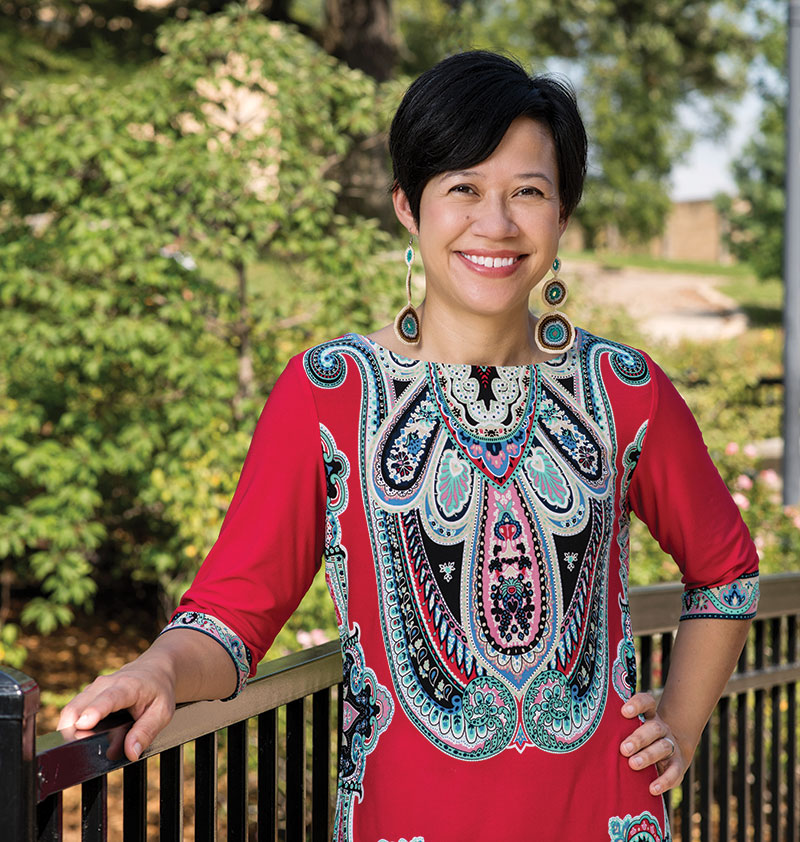
— Sherry Wagner-Henry, Director, Bolz Center
“The arts and humanities are more relevant to business education than some may think, as the power of applying creative approaches to complex problem-solving is increasingly recognized,” says Suzanne Dove, assistant dean for academic innovations. “By helping our students practice ways of knowing or doing from other disciplines, we offer them the chance to develop a valuable asset as business leaders, while also helping them grow as human beings.”
To reach even more students, the Bolz Center has been invited to develop a new master’s degree in arts and creative enterprise as a complement to the existing MBA in arts administration. Currently in the preliminary stages of development, the program would provide opportunities for creative majors to fuse their arts training with business and social enterprise curriculum, and give equal access to BBA students who want more arts-based coursework and perspectives on business development. The program would target students already on campus, with its curriculum presented in one year following completion of an undergraduate degree.
Gathering in celebration
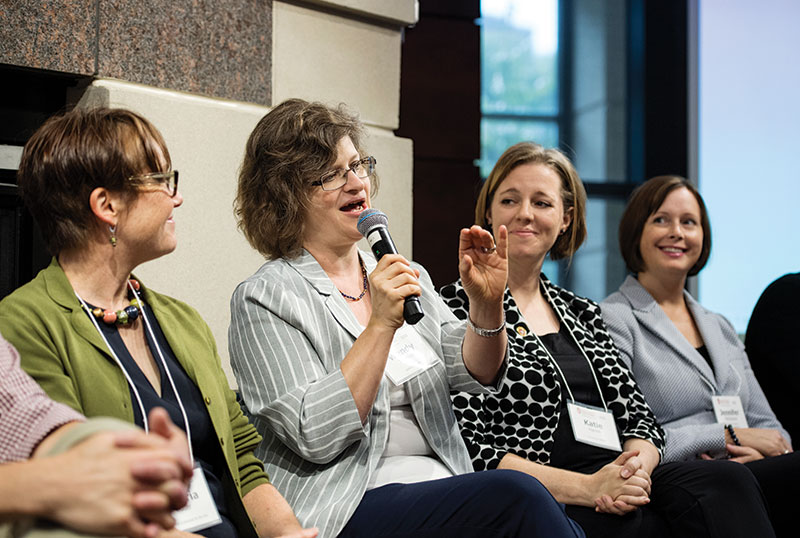
This fall, alumni and friends returned to campus for the Bolz Center’s biennial Collegium, a workshop for continued learning on current topics and trends. In light of the program’s 50th anniversary, this year’s event took on special meaning.
Recognizing that many Bolz graduates work outside of the arts and culture sectors, Collegium spanned a broad spectrum, all pivoting around a timely and relevant theme: 50 Years of Artful Leadership.
“Many arts administration alumni have found meaningful careers outside of the arts,” says Jodi Beznoska (M.A. ’05), chair of the Bolz Center advisory board and a consultant with Blue Water Communications. “But we all use what the Bolz Center taught us to infuse our own work with what we’ve taken to calling ‘artful leadership.’ We are incredibly proud of how our alumni have shaped a wide range of industries, from health care to higher education to social justice.”
For Wagner-Henry, the arts serve as a great connector, regardless of one’s career path.
“As I look at the Bolz Center and the many industries we impact, my goal is to help build leaders who are strong not only in the arts, but also in the community, in business, in government,” she says. “We can use the arts and creativity to build bridges and deepen connections. That’s been the Bolz Center’s legacy, and it’ll be our ongoing imprint in the years to come.”