The Creativity Conundrum
Professor Page Moreau’s research explores what can stand in the way of new approaches and ideas
Creativity is not child’s play. In fact, it might be the key element in making a business or product succeed.
Page Moreau, WSB professor of marketing and the John R. Nevin Chair in Marketing, has been studying creativity throughout her career, for good reason. In the past decade, much attention has been paid to what has been called a “creativity crisis” in the United States. Yet the 2010 IBM Global CEO Study asked 1,500 executives what the most important leadership trait will be in the coming years; the answer was creativity.
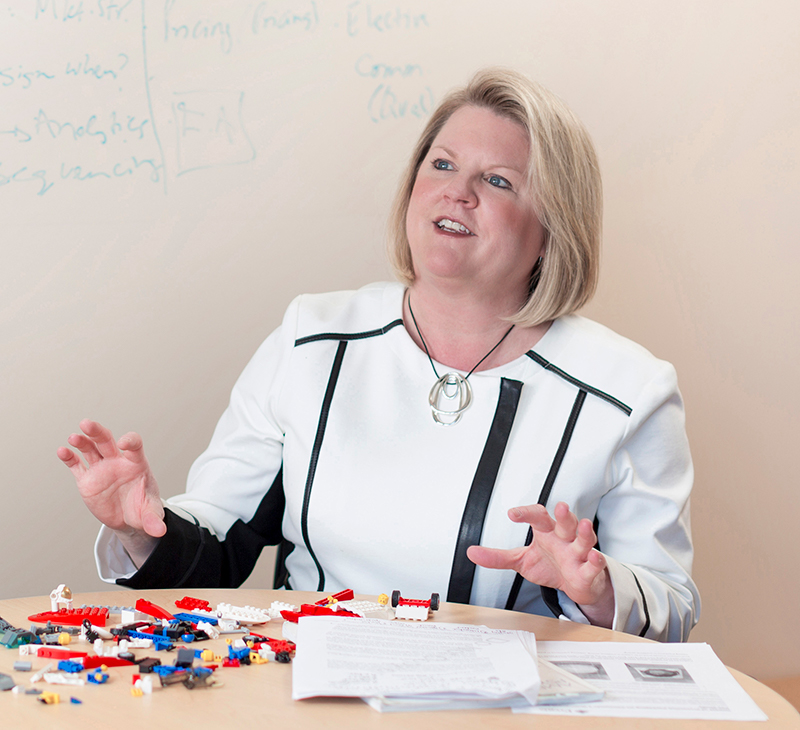
Moreau, also faculty director for the Center for Brand and Product Management, has spoken to alumni audiences about her work on creativity, including at the Wisconsin at Work event series in 2018. Among the research she speaks of is her use of Legos® to ascertain if working with loose bricks or assembling kits with directions can impact creativity on subsequent tasks. (Spoiler alert: It can.)
Moreau’s research has been featured in academic journals, as well as Inc., Psychology Today, Huffington Post, and public radio.
WSB: Why is creativity important in business education?
Page Moreau: Creativity isn’t just necessary for coming up with new products. It’s necessary for coming up with new business models, new advertising approaches, new marketing approaches, and new manufacturing methods. Taking a risk to implement something novel is the source of growth in just about every way.
I don’t think you can function without creativity, but the key is understanding which parts of the organization need creativity and which don’t. Disney is my favorite example. There is no creativity in their park workers—there is a certain script they follow every day. But at the other extreme there are the Imagineers who are creating all the time.
WSB: How did you come up with the idea to use Legos® in your research?
PM: I was feeding my son’s Lego® habit. There was little else he would focus on besides Legos®, and the bigger the kit, the more he would focus. He was about 8 or 9, and I thought, “Am I killing his creativity?”
And it turns out that Legos®, with the free-form sets and the kits, make the perfect metaphor. It’s an ill-defined problem versus a well-defined problem. A lot of us lament that kids don’t play anymore, that their activities are too structured. So maybe play would increase subsequent creative performance, but in reality it was the kit that suppressed creativity.
— Page Moreau,
Professor of Marketing and the John R. Nevin Chair in Marketing
WSB: Is it tough to teach ambiguity and ill-defined problems?
PM: It is. You can give people cognitive skills and tactics to try to structure things in a meaningful way. But so much of it is emotional. It’s discomfort and it’s fear, particularly with business students. It’s fun, but it’s not always easy.
WSB: Can people overcome that fear by learning to be more creative?
PM: In a lot of my work, I’ve looked at the factors and environment of the task—how do they impact creativity? Creative cognition work has this concept called the path of least resistance. We search our brains for a solution, and the ones we go to are the ones we most frequently implement and that yield the best results.
What I’m working on right now is looking at the role of color. Are you more creative if you have more colors to work with? Not surprisingly, people think they are more creative with more colors. But if you have a goal of what you want to represent, it turns out you’re better off with fewer colors because then you focus on the idea.
WSB: So you can foster creativity by creating rules for yourself?
PM: Yes. There’s this whole notion to think outside the box, but you need some sort of box. You need restrictions to help guide your focus. Creativity is a trait that people are afraid of at some level because they’re not sure if they have it or not. And it’s cognitively difficult. It’s generating things—not understanding and interpreting them—and that’s more taxing.
WSB: Pulling from your research, what can people do to be more creative at work?
PM: I think it goes back to the constraints. It’s challenging yourself to do even simple things differently. Go to work a different way every day so you’re not on autopilot, and you become aware of what is out there. You might see things differently by the time you get to work. Try to work in different places. I can’t write in my office because I’m supposed to write in my office, and that makes me not want to write in my office.
Shake it up, get out of your office, and question why you do things the way you do them. Try to be more like a 2-year-old and ask yourself, “Why?”