WSB Research: Now You Know
New WSB research that answers important questions
Q: Do emojis help or hurt a brand’s message?

Joann Peck
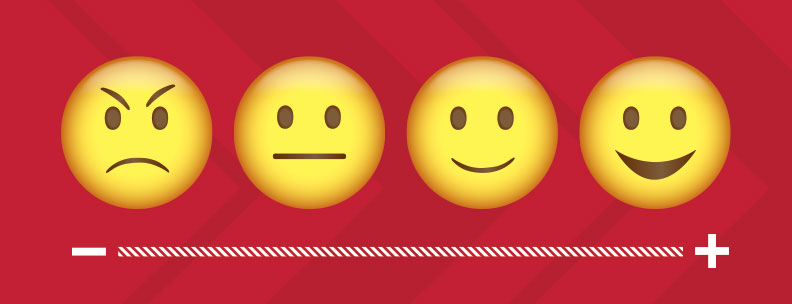
Let’s say a brand decides it wants to communicate like its customers do by adding an emoji or some funky punctuation here and there. How will the public react? With a smiley face? With the fury of a red, angry frown? With an ambivalence best conveyed by a shrug?
It all depends how those typographical tricks are used, according to research by Joann Peck, associate professor of marketing and the Irwin Maier Professor of Business, and fellow WSB scholars Andrea Webb Luangrath (BBA ’10, Ph.D. ’16) and Victor A. Barger (MBA ’02, Ph.D. ’11).
Emojis are part of what are called textual paralanguage (TPL), or nonverbal communication in text. They’re common in social media, where brand accounts use them much like anyone else on Facebook or Twitter does. TPL is a way for brands to appear relatable, the researchers conclude, but it’s important not to go too far.
TPL can convey warmth or friendliness, the study shows, though there is a danger in the brand looking too informal or being perceived as lacking competence. That’s partly why TPL use is more effective with consumer brands than, for example, a bank. Some brands even have an option: TPL use by a company “spokescreature,” such as the Geico gecko or the Energizer Bunny, has no impact on perceived competence.
Language is fluid, which makes the challenge of connecting with consumers a continually moving target. Yet if a brand has the right understanding of its market, an emoji could be just the right tool to make its customers  .
.

Q: Do looming elections delay regulatory actions?

Tyler Leverty
As elections approach, it seems that everyone is busy—from pollsters to candidates to reporters. One group, however, is a little less busy every four years: state insurance regulators, who are less likely to take action as elections loom.
That’s what Tyler Leverty, associate professor of risk and insurance and the Gerald D. Stephens CPCU Distinguished Chair in Risk Management and Insurance*, found by studying 21 years’ worth of data that included approximately 3,200 firms and 300 elections in 50 states. Leverty found that the probability of a regulatory action on a failing firm falls by 78 percent in the year before an election.
A regulatory intervention signals that a firm has failed, and public officials want to relay good economic news before an election. Leverty’s research shows insurance regulators—appointed or elected—often delay interventions before elections. However, elected regulators delay more than appointed ones, and the delay is greater during a tight election.
The research, featured in Business Insurance and other publications, illustrates how politics can affect what should be apolitical regulations. It also shows the impact on consumers. Delays cost money—nearly 50 cents for every dollar of a company’s pre-failure assets—and an insurance company’s customers and taxpayers bear the brunt of it.
Insights about delays could inform decisions about who might more effectively lead the regulatory task—an elected or an appointed official—because when it comes to efficient handling of some regulations, elections have consequences.
* Leverty also holds the John and Anne Oros Distinguished Chair for Inspired Learning in Business, which funds his work on a special project to assess student performance on cross-cutting learning outcomes: analytics, communications, teamwork, and navigating uncertainty.

Q: Do employees perceive a difference between male and female supervisors?

Maria Triana
Generally speaking, giving someone the benefit of the doubt is a kind thing to do. It turns out, however, not everyone gets that same benefit, notably women in leadership positions.
Maria Triana, associate professor of management and human resources and the Kuechenmeister-Bascom Professor in Business, explores gender stereotypes and subconscious bias in leadership, integrating her findings into a class she teaches on managing diversity in organizations.
Triana studied two female-dominated workplaces to ascertain supervisors’ ability to instill organizational commitment in their employees and how it differed by gender.
In a hospital in Turkey, Triana found that male supervisors who were less qualified than their subordinates had more committed employees than female supervisors whose credentials were superior to their subordinates’. For female supervisors, their credentials worked against them.
In the U.S., female supervisors instilled confidence in and commitment from their primarily female staff if they had impeccable credentials. Once there was any doubt about a female supervisor’s qualifications, employees’ commitment diminished.
In short, male supervisors got a benefit of the doubt that female supervisors did not. Today’s workforce includes more female managers than in the past, so it’s important for perceptions about female leadership to change, Triana says. Stereotypes and bias don’t just harm the supervisor; they can impact an entire organization.

Q: Do e-visits with patients increase a physician’s efficiency?

Hessam Bavafa
In theory, increased access to a physician would seem to be a healthy option, and today’s technological advances make it possible. But as it turns out for many patients, additional access to their doctor might not be the cure for what ails them. It may not be so great for the physician, either.
Those are the conclusions Hessam Bavafa, assistant professor of operations and information management, and two collaborators drew from a study of five years of health care encounters for more than 140,000 patients. The “encounters” were in person and through e-visits, electronic communication between patients and physicians.
Though considered a low-cost alternative to office visits, the research shows e-visits result in six percent more office visits, increased work for physicians, a 15 percent reduction in the number of new patients health care providers can see, and no discernible improvement in health outcomes.
An e-visit might cause patients to overreact to minor symptoms, or their unclear description of symptoms might lead to a follow-up office visit. The chance to resolve the situation online disappears and with it, the hoped-for efficiency of the e-visit.
However, the research also shows that e-visits have the potential to be an important part of health care operations. With a closer look at what kind of providers best use e-visits and how, they could turn out to be just what the doctor ordered.
Want more business insights you can trust?