Now You Know
What might the 2020s mean for business? WSB faculty offer ideas based on their research and experience
Q: What changes do you see in your field in the next decade?
INNOVATION

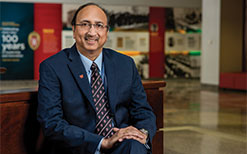
Hart Posen
The next decade’s most innovative new product is probably already here. At least, sort of.
Hart Posen, professor of management and human resources and the Richard G. and Julie J. Diermeier Professor in Business, studies innovation and believes most people think about it incorrectly.
“The notion that innovation is a light-bulb moment is not only fiction, but it undermines the innovation process,” Posen says. “The real process often involves a lot of recombining and imitating other things. We just don’t realize it.”
That misconception, Posen says, can have implications on how firms innovate and on policies geared toward encouraging innovation.
Posen uses the iPod as a prime example. Apple introduced it in 2001, but other portable digital music players beat it to the market by two or three years. The iPod wasn’t that different from other companies’ portable music players, but it moved the idea forward with a device that worked neatly with a computer software solution to manage users’ music libraries, and easily load music onto the player.
“The innovation wasn’t the iPod. The innovation was recognizing and adding a critical component to a product that was already there,” Posen says.
You look ahead by looking back or looking around, Posen says, which is why “the next big thing” is probably out there already—in some unfinished, undiscovered form.
"It’s probably just sitting there waiting for that one other part,” Posen says.
BRAND AND PRODUCT MARKETING
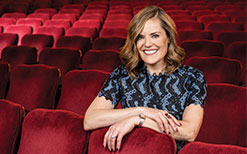
Page Moreau
In an era of same-day delivery and shopping for cars via cellphone, it’s clear that technology has upended the entire retail industry.
This disruption forces brands to consider not just what they’ll do in the coming years, but what they will mean to people.
“Technology has changed how people function in society, and that has an impact on brands,” says Page Moreau, professor of marketing, John R. Nevin Chair in Marketing, and faculty director for the Center for Brand and Product Management.
Beyond impacting delivery, Moreau says, technology has changed how people interact with a brand. “Brands aren’t orchestrating the environment in which consumers are making their decisions anymore,” she says. If a customer’s first physical exposure to a product is a beat-up brown box that shows up at their door rather than a beautiful display at a store, will that affect perception of the brand?
Brands might become less important if people work more remotely, Moreau says, with less of a need to express identity through brands if there is less contact with other people.
On the other hand, customers might become truly brand loyal because of one big human element—laziness. When your smart speaker prompts you to reorder your last purchase, it’s easier to comply than to shop around and consider other options. Companies will have to understand the different ways people make decisions.
“We’re just seeing the tip of the iceberg,” Moreau says.
BANKING

Jim Johannes
Anyone who saw their bank change from Norwest to Wells Fargo or M&I to BMO Harris already knows banking has changed over the years. Look for more waves of change in the next decade, says Jim Johannes, professor of finance, Aschenbrener Chair in Finance, and senior associate dean for faculty and research.
“When I started teaching, we had 14,000 U.S. banks; now we have 5,000,” says Johannes, who came to WSB in 1984. “There’s a dramatic change in the banking landscape, and that’s going to continue."
The structure of banking will change, too. That already has begun, with the emergence of “shadow banks” that compete with traditional banks. Traditional banks make loans funded with pooled customer money. Shadow banks make loans with funds pooled from investors. Quicken Loans is the most common example.
Shadow banks aren’t regulated the way banks are. Because of that, shadow banks are accepting some of the risk banks have avoided since 2008’s financial crisis.
“What will be the regulatory structure that shadow banks will have to abide by so the banking system is more stable, not less stable?” Johannes says. “That’s a huge issue.”
Digital currencies will make their presence known, too, Johannes says, leaving unanswered what that will mean for banks.
“Digital currencies will become more common at some point because the world demands them,” he says.
RISK AND INSURANCE
Joan Schmit
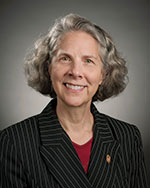
As the world becomes increasingly intertwined, challenges loom for the insurance industry, says Joan Schmit, professor of risk and insurance and American Family Insurance Distinguished Chair in Risk Management and Insurance.
“With economies interdependent and powerful networks sharing information, the insurance industry’s ability to provide the level of needed capital when major events unfold is unclear,” Schmit says. “Storm systems are becoming more frequent and stronger, and assets exposed to their damaging effects are rising in value. Beyond these physical outcomes are the intangible assets people place in the cloud, which could be lost in one major event through network disruptions and/or hacking.”
Insurer partnerships with governments and the capital markets will become more common to deal with these interconnected loss events, Schmit says.
At the same time, the sources of data and the ability to employ them with artificial intelligence are increasing, adding value to what insurers can accomplish, Schmit says. They can predict losses more precisely, understand consumers more deeply, and offer their services more efficiently. Yet they are more likely to rely on automation, changing the nature of work in the insurance field.
“More data scientists, more behavioral economists, more systems engineers will be needed,” Schmit says. “The future is exciting, and the need is large.”
Want more business insights you can trust?